



Antistatic Epoxy Based Static Coating DFC – 440

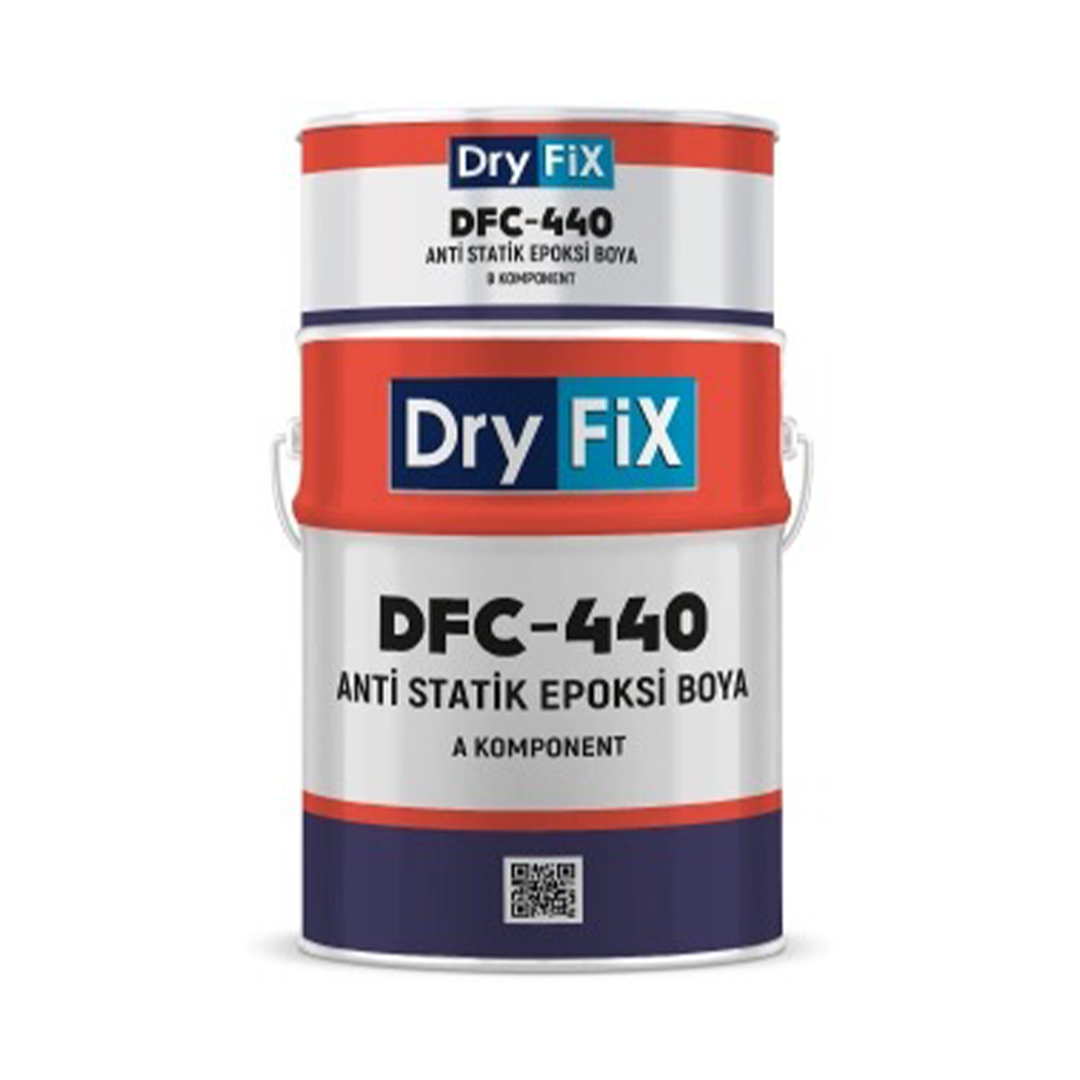
DryFiX DFC-440 Premium Anti-Static (Conductive/ESD) Epoxy Floor Coating
Invincible Conductive Armor Against Static Electricity in High-Security Areas
DryFiX DFC-440 is formulated to the highest engineering standards specifically for high-security industrial floors where the accumulation of static electricity poses vital risks or where the grounding of sensitive electronic devices (ESD - Electrostatic Discharge) is mandatory. Based on a two-component, 100% solid, and solvent-free epoxy resin, this premium topcoat utilizes special conductive (carbon/graphite) agents to collect the static charge generated on the surface or transferred from the human body, safely discharging it to the earthing line via an underlying copper grid.
It is utilized as the ultimate (topcoat) protector of the "Anti-Static Floor Coating System" in high-risk explosive and ammunition manufacturing plants, operating rooms where sensitive devices are active, laboratories, server (data) rooms, electronic component production facilities, and specialized warehouses. Boasting high mechanical resistance, chemical durability, and a smooth surface finish, DFC-440 guarantees the electrical safety of the environment while creating a long-lasting floor capable of withstanding heavy pedestrian and light vehicular (pallet jack) traffic.
DFC-440 Technical Specifications and Electrostatic Performance
| Performance Criterion | Technical Values and Details |
| Chemical Structure | Solvent-Free Epoxy Resin Fortified with Conductive Agents |
| Appearance and Finish | Matte Finish |
| Color Options | Special RAL Colors that do not affect electrical conductivity |
| Solid Content (By Weight) | 100% (Solvent-free structure, non-shrinking/non-sagging) |
| Mixture Density | 1.30 ± 0.05 g/cm³ |
| Packaging (As a Set) | 25 kg Two-Component Set (20 kg Component A + 5 kg Component B) |
| Mixing Ratio (By Weight) | 4 : 1 (4 Parts Component A Resin / 1 Part Component B Hardener) |
| Consumption (Coverage) | Average 0.300 - 1.200 kg/m² (Varies depending on the desired film thickness) |
| Pot Life | 40 Minutes (at +25°C ambient temperature - Shortens as temperature rises) |
| Electrostatic Response (IEC 61340-4-1) | Resistance to Ground (Rg) < 10⁶ Ω (ohms) |
| Average Ground Resistance Limits | 10⁴ ≤ Rg ≤ 10⁶ Ω (ohms) |
| Recoat Interval | 12 Hours (at +25°C ambient temperature) |
| Full Mechanical & Chemical Cure | 7 Days (Preparation time for heavy industrial exposure and electrical testing) |
Professional Application Instructions and Anti-Static System Installation
Applying an anti-static (ESD) floor is a highly technical process compared to standard epoxy coatings and must be executed as a complete "System" (Standard Primer + Copper Grid + Conductive Primer + DFC-440 Topcoat).
1. Substrate Condition and Surface Preparation
- The concrete substrate must have a minimum compressive strength of 25 N/mm² and a pull-off (tensile) strength of at least 1.5 N/mm².
- Oil, grease, dust, weak laitance layers, and old paint flakes that hinder adhesion must be completely removed using mechanical methods (diamond grinding or shot-blasting).
- Any pressurized moisture or water (negative hydrostatic pressure) rising from the substrate, even after the product is fully cured, will disrupt the conductivity of the anti-static system and damage the epoxy. Therefore, the substrate's waterproofing must be flawless, and highly absorbent surfaces must be primed repeatedly with the DryFiX Epoxy Primer series until fully saturated.
2. Installation of the Copper Earthing Grid
- After the bare concrete is primed with a standard DryFiX epoxy primer and allowed to cure (approx. 12 hours), self-adhesive copper tapes are laid out in a grid pattern (usually 1x1m or 2x2m squares) to provide the primary conductive pathways.
- The terminals of this copper tape grid must be securely and mechanically connected to the building's main grounding busbar (earth line), verified and approved by a certified electrical engineer.
- A special carbon-black infused "Conductive Primer" (e.g., DFC-106) is applied over the copper tapes using a roller to collect the electricity and channel it to the copper, which is then left to cure.
3. Component Integration (Mixing DFC-440)
- Component A (Resin) is briefly mixed mechanically within its own bucket to ensure the complete and homogeneous distribution of the heavy conductive carbon agents that may have settled.
- Subsequently, Component B (Hardener) is added into Component A, strictly adhering to the 4:1 weight ratio. The materials must never be arbitrarily divided.
- Using a low-speed mixer (300-400 rpm), the components are mixed continuously for at least 3-4 minutes until a smooth consistency is achieved, taking care not to entrap air. As the pot life is 40 minutes, application must proceed immediately without delay.
4. Topcoat Application System and Notched Trowel Technique
- Following the curing of the conductive primer (DFC-106), ensuring the copper grid is completely concealed, the prepared DFC-440 anti-static topcoat epoxy mixture is poured onto the floor and spread evenly to the desired thickness using a notched steel trowel.
- To eliminate trowel marks and release any entrapped air bubbles from the mixture, the freshly applied wet surface must be de-aerated by cross-rolling with a spiked roller immediately after troweling.
5. IEC 61340-4-1 Conductivity Testing and Acceptance Criteria
- Once the floor is fully cured (after 7 days), an electrical conductivity test is performed using a Megohmmeter by certified institutions.
- The distance between the conductivity measurement points (probes) on the floor must be at least 50 cm.
- If any points yield insufficient results (< 35 MΩ) during the measurement, additional verification measurements must be taken within a 50 cm radius of those points. A measured resistance to ground (Rg) falling within the range of 10⁴ ≤ Rg ≤ 10⁶ ohms proves the system is operating successfully.
6. HSE, Limitations, and Safe Storage
- During application, the ambient and surface temperatures must be between +10°C and +30°C; extremely humid environments must be avoided.
- This product is for professional use only. Due to its chemical components, strong ex-proof ventilation must be provided in enclosed spaces. Nitrile gloves, active carbon respirators, and safety goggles must be worn. Refer to the Material Safety Data Sheet (MSDS) for emergencies.
- All tools used (trowel, spiked roller, mixer) must be cleaned immediately with Epoxy Thinner before the epoxy cures.
- Product packaging must be stored between +5°C and +35°C in dry, enclosed storage areas away from direct sunlight.
Our team will contact you as soon as possible to offer the most suitable solution for your needs.